
Pre-pandemic, I would be on a plane every other week. I also spent hours driving. I felt guilty if I did not visit my locations in Findlay, Brockton, Saratoga, Tolleson etc. And I felt I needed to network so Id go to meetings and trade shows. I felt I needed to support special in person events.
Pre-pandemic, I would accept most invitations for lunch, dinner, and meetings in person. With the schedule, I had added 2-3 hours of drive time. Even when there were no meetings, my calendar often ran 8 to 10-hour days.
Pre-pandemic I would often eat out a lot. Not a big deal but that added 1-2 hours into my work week with Kpktoto depending on the location (even if I ordered in, I had developed good work out habits) at home but I always could stand to lift weights more.
Pre-pandemic, a speaking engagement could take me 4 to 5 hours with prep, travel, schedule and get ready for an event. These were replaced by podcasts which take only 30-60 minutes.
In the pandemic, I estimate I wasted 20-35 hours per week I got back.
Some things I miss in pandemic have been hugs�. but somehow I now feel I am an introvert. I used to always say I have never met someone I like less than �me as man�. I accept meetings and things with higher thresholds than before. That is partly what fills my calendar.
So pandemic I thought I had to do all these things to be effective, now I choose the ones that matter.
So what would bring me out of blog retirement? A granddaughter that wants to do a guest blog post:
Coconut Macaroons
- 4 cups sweetened shredded coconut
- 1 cup sweetened condensed milk
- � teaspoon salt
- 2 teaspoon of vanilla extract
- 4 large egg whites
- � teaspoon cream of tartar
- 2 tablespoons of sugar
Wash your hands and put your hair up.
Preheat the oven to 325�F. Line 2 cookie sheets with parchment paper and butter the paper.
In a large bowl, using a fork stir together the coconut, condensed milk, salt, and vanilla.
In the bowl of the stand mixer combine the egg whites and cream of tartar. Beat the egg whites on medium speed until foamy, about 1 minute. Turn the speed up to medium-high and continue beating until the egg whites look shiny and smooth and they form soft peaks � about 2 to 3 minutes. Slowly add the sugar then mix in the mixture until it forms stiff peaks.
Using a spatula gently mix half of the egg whites into the coconut mixture just until blended, then mix in the rest.
Scoop big tablespoons of batter onto the cookie sheets. 12 per cookie sheet = 24 total.
Bake macaroons one cookie sheet at a time until the tails are light brown (17 to 20 minutes).
Remove the cookie sheets and set them on a wire rack and let cool for 5 minutes. Then take macaroons off the cookie sheet and let cool directly on the wire rack.
Enjoy!
Recipe from: American Girl Baking: Recipes for Cookies, Cupcakes and More by Williams-Sonoma
I thought I had a solid marketing plan - then I read Branding in a Digital World - How to Take and Integrated Marketing Approach to Building a Business by Hilary Topper. I learned from it (and as a constant learner, I love books that help me learn).
The book delves into virtually all social platforms. It explains their use, advantages and disadvantages. One of the axioms Hilary puts forth is the democratization of media - it is no longer just about traditional media but about all the blogs, tweets, posts, videos, photos, podcasts etc from average people.
Hilary herself has an impressive social media footprint.
I see one downside for some people on social media. They want to live an Instagram or FaceBook life. So they spend their time trying to look good and interesting while detracting themselves from really living.
There was a chapter (page 144) called "Do you need to be on Linkedin". I raced to this section since that would be my primary platform. I do not love the messaging (takes an extra few seconds and is not as organized as my email).
Hilary calls Linkedin her least favourite platform. So we have some disagreement in that one. I use Linkedin extensively for business.
I post daily on Linkedin and do follow my stats there (unlike all other social media platforms that I largely ignore). In a way, I feel I have created my own publication with readers of my choosing.
I use Linkedin as a marketing tool. EG - If I think Danby is not selling enough to TSC store (Tractor Supply Company), I would reach out to TSC and connect to everyone I can there. Not everyone from TSC would read my posts but some would. Then when something like the current freezer shortage happens - they think first of Danby.
One thing I like about Linkedin is people keep their own contact information. When they change companies, I am still in contact with them.
The main downside for me from social media in general is volume. I try to be polite and reply but the volume can simply get just too high. This does not stop me from posting on Linkedin, FaceBook and Twitter but I often do not look at the responses I get there.
One large social platform I do not yet do is Instagram. (I use the phrase "not yet do" so I do not limit myself - it keeps open possibilities. EG - golf is one sport I do not yet do). And I do not use many of the other platforms like Pinterest, TikToc, Tumblr... and the list goes on.
I use social media to amplify press. EG - if I have an interview in a publication or a podcast, I send that out on my social media feed.
I know another downside of social media is using it idly can waste hours. I know I can kill an hour easily reading Twitter feeds, Reddit or Quora or answering Quora questions. On the other hand, if this is entertainment, perhaps that is not bad.
There was a good chapter on "Social Media in the age of Fake News" that I found interesting.
Great book. Good work Hilary.
�When we are no longer able to change a situation, we are challenged to change ourselves.� - Viktor E. Frankl
�An abnormal reaction to an abnormal situation is normal behavior.� - Victor Frankl
Dr Victor Frankl was Jewish and a holocaust survivor - including surviving the now famous and terrible Auschwitz. He wrote a famous book about his survival called "Man's Search for Meaning". It is a must read.
In it he spoke about those people who died. Those people who said to themselves (and others) "we will be out by January 1" were the ones that died. I read people saying this covid crisis will be over by X. I am not so sure. I think it will not end on a day. I think it will be gradual. And there is a high likelihood it will take much longer than expected.
We have life during covid. Seek to maximize that. Living in the past or the future can negate the value of the now. Our lives are still good - even now. Much of what people are suffering from are the effects of covid - not actually covid. For example - I do not know anyone who has died from covid. I only know a friend of a friend who has it bad. Everything I am dealing with is the reaction in the economy, in business, in the change in my daily routine.
I speak about cherishing the moment but I, too, think a lot about the future. In business, I think about Danby. As people spend more time at home, they will need more fridge space. They will entertain more and need more wine coolers. And freezers are already in short supply. Of course our hotel and academic sales will be down.
For ShipperBee, I see more ecommerce and more shipping. It is difficult to sell now because no one wants to change couriers but the future looks bright.
Of course much of Man's Search for Meaning spoke about purpose. Purpose is the reason people survive and thrive.
One secret to happiness is gratitude. When we compare our situation to the holocaust, we can realize how grateful we should be.
Make the most of the day.
++++++++++++++++++++++
And one thing people can do to help save the world is here. I have eaten that way for years and enjoyed it and do not feel any hardship.
Covid is the crisis of our time. The only thing I like about it is it is not people killing people - rather it is the whole world against the virus. It is uniting.
As the virus unfolded, I could see the need for ventilators. So perhaps 7 to 8 weeks ago, I put the Danby designers and engineers on figuring out what we could make. The design criterion was � something we could start production in 2 to 3 weeks with parts that are readily available in Canada.
As an impatient entrepreneur, I just wanted to do it. Quickly we realized that we simply did not have the capability to do this design. So we started to bring in other people and companies to help. One of the first people was highly energetic Rick Jamieson of ABS Friction. He even calls himself Chief Energizing Officer of this project. He has been amazing at driving this project forward.
He brought in one of my other YPO friends, Scott Shawyer from JMP Solutions and one of his friends Paul LHeureux of Crystal Fountains. Both of these companies would prove invaluable.
Due to the urgency, we followed (and still are) different paths.
On the design-our-own path, Crystal Fountains stepped up and using their awesome rapid prototyping, designed and built a design from an open source. I was very impressed with Crystal Fountains staffs speed, quality, and professionalism. It is not a true ventilator but an ambulatory bag pusher. It is less invasive than a ventilator. If someone shows up at a hospital and needs a ventilator and none is available, this is a perfect solution. It can also reduce the time spent on a ventilator by weaning someone off the ventilator and onto this unit. This video will give you a full idea of what this unit is.
These units are in production now and ready to ship. We just need names of hospitals that want them.
Our second path was to produce an open source Medtronic design. To do this, we again needed someone with medical production and expertise. This spawned the relationship with Baylis Medical.
This press release on the Baylis site says it all. We will be building thousands of these units. The advantage of them is they are professional, well tested units. Health professionals know how to use them. And they will have a life far beyond Covid and can be used in hospitals for years.
We still have a third path but we have not announced it yet (partly because it is not completely nailed down).
So we are a work in progress trying to solve the ventilator shortage for Canada. And after that, we will turn our energies to the world need.
The need for ventilators will be huge in Africa (unfortunately). See this Atlantic article.
Stay safe. And go wash your hands.
�There are decades where nothing happens; and there are weeks where decades happen.�
This is a few weeks where much has happened.
I see from the Johns Hopkins site that the US has a solid lead on the rest of the world on covid cases. China seems to be quite level and under control. I am wondering if that might be the compliance of people. In North America, people tend to ignore government authority more.
I am in business so I am closely attuned to the economy. This is hurting trade. There are some winners (like Iotum Callbridge, grocery stores (people are eating at home more), Danby freezers, vitamins and supplements, masks etc.). But overall, the economy has dropped. The real question is where this comes out and how fast do we recover.
As a business person, I always try to predict the future. For ShipperBee, the future is bright. I see nothing but more ecommerce and delivery.
For Danby, I see less wine coolers and bar fridges short term (people feel poor and have less $). Less compact fridges in hotels (although now is a good time to renovate so it may hold up). Work at home though will drive people to buy second fridges. Less Caribbean vacations and more entertaining at home might cause people to buy more wine coolers. Freezer sales have increased permanently - people will think more "be prepared". Danby is also well suited for small space living so with less money, people are more likely to live in smaller places.
What is good about this pandemic:
- It is all of humankind against a common foe. This feels better than people killing people.
- This may be just the kick the environment needs to right itself.
- I think this period of social distancing is helping people clarify who they are. My hope is it will make it a kinder, gentler world.
- There will be some infrastructure savings. Less new roads will be needed as more people work from home. (unfortunately, those savings will not offset the massive government costs to fight covid)
Danby is hard at work designing ventilators with the hope of producing them soon. As we started the project, we found we lacked the full capability to make them so we have formed a very strong consortium. Lots of time. Lots of challenge. More on this later.
And some wisdom from 1848:
�What has so often excited wonder, is the great rapidity with which countries recover from a state of devastation, the disappearance in a short time, of all traces of mischief done by earthquakes, floods, hurricanes, and the ravages of war. An enemy lays waste a country by fire and sword, and destroys or carries away nearly all the moveable wealth existing in it: all the inhabitants are ruined, and yet in a few years after, everything is much as it was before.�
� John Stuart Mill, Principles of Political Economy, 1848
I am old school. I prefer in person. I like to see people in the office. I often learn things just from casual interactions in the office. When someone is not there, I find I often end up speaking with someone else about what is on my mind so the person is also excluded.
Some tricks:
- Have a dedicated space. There is nothing like a space that says "now I am going to work" to prompt action.
- Avoid distraction. For me, that would be news sites or stock markets. For some people, it might be TV or FaceBook or other things. You know what your weaknesses are � avoid them.
- I know your manager will be stressed. Worried the work is not getting done. Put him or her at ease with a couple of video calls (works way better than just a phone call) and a daily report. The format I like for a daily report: "my goals today were... I accomplished... things you should know... my goals tomorrow are... and things I need from you".
- Avoid temptation. If you have unhealthy food in stock, you will likely eat it. Only stock the healthy stuff.
- Plan. I know I work better in the office OR at home if I have a plan. One trick I do is say "what are the top 3 things I will have done today". Invariably I get them done � just because of this planning.
- Much of my success can be attributed to habits. Good work at home is about having good habits.
- One of the first things I would do is study it. Google. Search YouTube. There is a ton written on this.
A PC Magazine article on it here.
And more (not in my words):
How to make the most of working from home:
- Your office is your state of mind
Pretend you are going into the office. Do all the things you do to prepare for your office role: set your alarm, make (or go get) coffee, and get dressed. - Choose a dedicated workspace
Rather than relaxing in your bedroom or on the couch � spaces associated with leisure � dedicate a specific space in your home to work. - Set work hours
Establish set work hours and communicate them to colleagues and family. - Have a work plan
Identify what needs to be done each day and follow through with a strategy to complete it. - Take short breaks
Schedule short five-minute breaks. They actually increase productivity and creativity. - Use a rewards system
After completing a difficult task, reward yourself with a stretch, snack, or short chat. - Use Video Conferencing or phone calls
Stay connected with your team using apps like:
� Skype
� Callbridge
� WhatsApp
� Facetime
� Google Hangouts
� Zoom Meetings - Family, Friends, and Pets
Welcome their company but clearly communicate your work hours and break times.
I am a very big proponent on reducing greenhouse gas and doing less bad things to the environment.
According to Dr Google:
EPA reports that aircraft contribute 12 percent of U.S. transportation emissions, and account for three percent of the nation's total greenhouse gas production. Globally, aviation produced 2.4 percent of total CO2 emissions in 2018.
One side effect of coronavirus I see is people are traveling less. I have had conferences cancelled. And I have made decisions to travel less myself. My air travel is my personal largest greenhouse gas contribution.
So the net of it � less greenhouse gas from travel.
One way people will do meetings instead is using video conferencing. I have an investment in a video conference company � Iotum that has a solution CallBridge. They may benefit.
2 great links to coronavirus information here and here.
When you look at the demographics of who dies from it � health is an obvious link. EG: 15% of over 80 people who get coronavirus die, for those 40 to 49 it drops to 0.4%. And if someone has no pre-existing health issue, their chance is only 0.9%.
Of course statistics do not take away from the sadness for those who died and lost loved ones. It does speak to being healthy though.
I notice that smoking is one thing that contributes to death. Interestingly, less GHG and less particulate in the air will help people's health. So less travel could be a double benefit (although small).
I have often noticed "unintended consequences". I wonder if one unintended consequence might be lower immune systems in people because they use too much hand sanitizer. Our bodies need a few germs to get good at fending them off. This said � I am likely one of those who is washing and sanitizing too much.
This could also contribute to super bugs that need to morph to get around sanitizer.
++++++++++++++++++++++++
I am big on habits. Thought this article might inspire.
I suffer from blogger guilt. Basically I do not write much. Not even sure if I should. But today, something is on my mind so I am.
I know when my mother was alive she read them all (and dutifully sent me corrections if needed). At one point she asked me "how are you doing" � I replied "don't you read the blog � you should not have to ask". I miss her.
++++++++++++++++++++++++++
My heart goes out to those impacted by coronavirus.
Coronavirus is scary but needs to be put into perspective. This year in North America, 130,000 people have been hospitalized with the flu and 10,000 have died. This compares with 2,700 deaths from coronavirus (and 99% of those are in China). This site is excellent for tracking.
Maersk has cancelled 50 sailings of container ships. This will be almost $5B in goods � 2.5% of the US GDP. This will create some shortages of product. I do not yet know the impact it will have on Danby.
And we researched it. Coronavirus does not live outside the body for more than 7 days (and only then in perfect conditions). So any product that is shipped by ship from China to North America has no chance of transmitting the virus.
And speaking of China, ShipperBee would appreciate introduction to any ecommerce companies (who often source in China) who might like to save money on shipping while saving 73.1% of the greenhouse gas per parcel.
Happy Thanksgiving. We have much to be thankful for...and much still to do.
You can be thankful...if you can read this.
You can be thankful...that you are alive
You can be thankful...for health (even if only some parts are healthy)
You can be thankful...not to go hungry tonight
You can be thankful...to have electricity
You can be thankful...for indoor plumbing and safe water
You can be grateful...for family
You can be grateful...for friends
What is your gratitude list?
Having a Gratitude Journal will change your life. See this article.
No � things are not perfect but having gratitude for what we have makes us stronger, healthier and happier.
+++++++++++++++++++
As ShipperBee begins selling customers on shipping parcels, we are beginning to perfect our sales process. Actually � sales process is never fully perfected � it takes continual work to hone it. Kaizen � continuous improvement.
One way to figure out the best process is to do a series of tests and track results. EG � take a 45 hour week.
- Try spending 45 hours knocking on doors and doing in person calls.
- Try spending 45 hours telephoning
- Try spending 45 hours connecting with people on LinkedIn.
Figure out which one works best. Of course, sales process is not about one thing � it is about a series of things.
Perhaps the best sales path is:
Phone ? get an email ? send an email ? visit ? send an email ? phone ? send a package ? call etc.
Or is it:
Connect on LinkedIn ? visit ? get an email ? send an email ? send daily LinkedIn updates ? visit ? call etc.
Everything is about tracking and testing what works. This includes everything from the source of the list � could be B corps (they resonate with the 73.1% greenhouse gas savings per parcel shipped), or it could be clients that ship 100 parcels per day because $1/parcel savings adds up to a meaningful amount.
Different clients respond to different advantages. We have found some clients like:
- Environment savings.
- 4-hour delivery guarantee.
- 2 to 3 day delivery for the savings.
- Some like the continuous pickup so parcels do not have to wait to be moved.
The message: track process, test process, repeat to polish your sales systems.
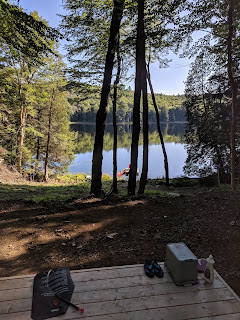
I recently took a week off. Like the photo � a time to reflect. I run my life fast and hard � meetings from early morning to late evening. I worry that this creates a short-term view. My greatest value is thinking strategically and long term.
Or as Stephen Covey says � "sharpen the saw". Take some time to sharpen the saw.
+++++++++++++++++++++
Since I was on holidays I allowed myself to read a "pleasure book" by a friend � Sue Williams � "Ready to Come About". It was a captivating true story of her and her husband, Dave, sailing the ocean alone.
Yes � it was an adventure of sailing, near death, cold, equipment failure, self-reliance, but what made it interesting is it was the story of personal development. Her personal story woven through the adventure.
Because I know Dave and Sue well, it made the story even more interesting. Dave is a conservative accountant and Sue is a non-adventurer (by her own account). They were an improbable couple to do such a journey.
I really enjoyed it.
+++++++++++++++++++++
I recently read an article on flywheels.
https://futureblind.com/2019/08/03/advantage-flywheels/
For many businesses or business problems, this is a great way of looking at things.
++++++++++++++++++++++
Unrelated. There is a simple and great concept � checklists. A book on the topic talks about how they can save lives in a hospital setting. They are good for less life and death situations also.
I get a lot of email. And I think the digital world has shortened my attention span. I lack tolerance for long emails, especially if someone is trying to sell to me. So I recommend a 3 second rule. If a marketing email cannot be read in 3 seconds, it is too long.
In 2009, I wrote a guest blog for my friend Hilary Topper praising short succinct writing. I still stand by those thoughts.
So that is my 3 second blog for today.
+++++++++++++++++++++++++++++++
Ok. tough to stop at just 3 seconds. As a leader, I think lack of attention span and focus can be detrimental. The biggest impact a leader can have is by spending long, high-focus periods on high priority tasks.
If we flit too much and do not go deep, we can never add our greatest value.
I love gardening...and I don't.
I like planning, planting and harvest. Not so keen on the weeds. I do love the results. I feel healthier eating food I have grown. At least I know it is organic.
And a bad side effect - I often do not bend properly so can end up with a sore back. And I have hay fever so it can make me stuffed up.
I do think a garden keeps one close to nature. So I notice how wet it has been this year. And the mosquitos are killer this year. So much so, I have often abandoned the trail I usually walk on in favour of walking on city sidewalks.
I only plant vegetables. Always the practical one.
I like the title of this article: Gardening can cure just about anything.
I am an exercise person and think being outside for at least 20 minutes daily is a good health practice. So you would think I would like mowing... but I detest it. I think this is mostly because of my bad allergies. I do wear a dust filter. And I have to shower right after I mow to get the pollen off. My lawn is small takes 21 minutes to mow. You would be surprised the number of things I can come up with to do to avoid cutting the grass.
Danby sells an air purifier details here. I have one in my office. It is a bit like vitamins though I think it works but I really cannot tell. But it is natural and simple so no downside in using one.
+++++++++++++++++++
I continue worrying about the environment. I read a scary book that is worth reading Uninhabitable Earth by David Wallace-Wells. A summary of the book is here. You can download the full book for free here.
I am working on a start up ShipperBee that can reduce the carbon footprint on parcels by 75%.
I tend to look at challenges as things to be solved. I also look at how to adapt.
I recently attended a board meeting of John F Wood Centre for Business and Student Enterprise. The topic centred around what sorts of things should a school such as that do.
And of course there was a lively debate about entrepreneurship - one of my favourite topics.
I believe television has created the myth that business ideas are mostly inventions. In reality, most money is made in business by people doing the same boring thing as every other boring business. Look around your city - who are the business people - the coffee shop owner, the landlord, the car sales place, the mini storage, the dry cleaner, the jeweller, the lawn care person, etc etc. Unlike Shark Tank and Dragon's Den - business is mostly NOT big invention - it is micro-refinements and good implementation (and hard work) of a boring business.
Entrepreneurship is also mislabeled. An entrepreneur should be willing to risk their time and money - by definition. What I see is people who say they are entrepreneurs want other people to risk their money so the "entrepreneur" can get paid a salary. Those same entrepreneurs want to retain most of the upside.
I also see businesses raising money when they should not - they should just be profitable and grow from those profits. Bootstrapping makes a company strong. Service companies particularly should not raise money.
I talk a bit about bootstrapping in my Ted Talk.
Perhaps I am just jealous because I had to bootstrap my business and no one paid me a salary.
++++++++++++++++++++++++++++++++++
I worry about climate and the environment. I saw an interesting article in the Guardian on The Best way to Save the Planet - Drop Meat and Dairy. I ascribe to that but am not yet vegan. I am a pescatarian (not a Roman Catholic). I eat fish and cheese and yogurt.
Ironically, I am economically conflicted. Danby has a robust business in dehumidifiers and window and portable air conditioners.
Still - my preference would be a good environment and I sell less.
++++++++++++++++++++++++++++++++
The US is at risk of falling behind with Crypto due to SEC regulations. See this Forbes article.
I am not blogging much lately but have had a few people say they follow my blog. Mostly I am sending quotes out on Linkedin so connect with me there.
But I will still sometimes blog here.
I often say I lead a charmed life. I have much to be grateful for. And often have milestones I should celebrate. Should is a guilt word for me. But is can also be a motivational word.
I was invited by Dave Kroetsch to a closing party by Aeryon Labs (they were recently acquired). They knew how to do it right. The band was Barenaked Ladies. They showed gratitude to the people who helped them achieve what they achieved. It was a good reminder for me to celebrate.
Like all lessons - leading by example beats writing about it.
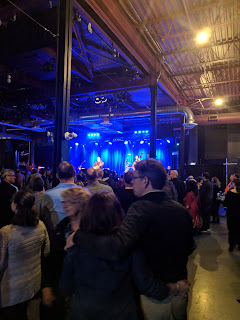
Today was my mom's funeral. It was beautiful and well done. And family surrounded us adding a special feeling for the day. I almost feel guilt for the good time we had together in such a time of mourning. I love spending time with my brothers, cousins, kids, nieces, grandkids etc.
In marketing, we often speak in terms of personas. Marketing to a specific 50 year old male who likes X. I realize at times like this that mostly I live in the persona of "business person" or "efficiency person" or "health person" or "constant learner". I know that is how I present here.
Most of those personas are shallow (but real)
But like all people, I have many aspects. We are all complete people. I am not sure people think about that with me. They see only the business person.
Unrelated but beautiful - I share photos of a trail I walk. Yes - power of while but mostly beauty. Most days I do 2-3 walking meetings on this trail:





The funeral for mom (Ann Estill) will take place 10:30am Saturday 2 March at Harcourt United Church at 87 Dean Ave., Guelph. A reception will be held at 12pm at the University of Guelph Arboretum which is accessed off College Ave.
Should you wish to make a donation in Anns memory please consider:
My brother Lyle wrote a good FaceBook post on her life:
Burying Annie
I lost my Mom last night. My brother Jim found her dead on the floor this morning. That is all. Gone. I got the word mid-morning. Arlo and I were working on Hempsmiths tax return. I was making scones.
It was a cold, rainy, miserable February day. Our phones do not work in our house�so taking calls involves walking around outside in the rain. Horrible. My cell phone exploded with the news. Wet feet from pacing about the lane in my slippers taking and making calls.
I embark on the long drive to Canada tomorrow.
Mom was born in 1931. Ann Aurelia Wilcox in Highland, New York. She married my Dad, Don Estill, in 1953 when she was 22, and launched four boys into the world. I never really called her Annie. That was an affectionate nickname used by Dad, and by her little sister, Boo Boo.
When I was in high school Mom completed her Masters of Divinity and became a minister. I had a front row seat. She did a booming trade in funerals. I used to call her �Burying Annie,� and she loved the moniker.
She was a feminist at the dawning of the movement... [cut for brevity in preview; insert full text as needed]
She was scheduled to help pack food today for refugees and Danby Appliances. We had over 100 volunteers lined up and were packing hundreds of kg of food to ship overseas.
The people who were bringing her told me she did not answer the door or the phone so I left almost as soon as I arrived at Danby. I called and rang the doorbell and pounded then I went in (she lived alone, my father passed a few years ago). She was dead on the bathroom floor. 911 could not revive her.
It was unexpected. She was a bit deaf and going blind but she was fairly healthy and I expected her to be around for many more years. She was 87.
She was married to my father for about 60 years and I knew she still missed him. The second greatest tragedy for her (and all of us) was when my dear brother died 10 years ago.
She was active to the end - telling stories, going to aquafit, writing memoirs, going to symphony, attending movies and lectures in the Arboretum Centre etc. And she had a wide circle of friends and was always having lunch or talking to someone.
She was always the first to tell my my blogs had a typo, grammar error or needed some other correction (so now I have an excuse).
She never really liked business and did not really grasp what I do. She even tried to mandate "no business talk" at the dinner table (which of course did not really work...unless she wanted silence).
She was worried about me and thought I worked too hard and should slow down.
Although it feels at this moment like there is no blessing in it - there is. She must have died quickly - she had a lifeline on her wrist and she did not even push it. And she always said she never wanted to move to a home - or even the apartments in her complex. So she lived in her house to the end.
Now I feel like an orphan (and I guess I am)
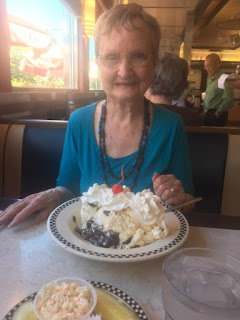
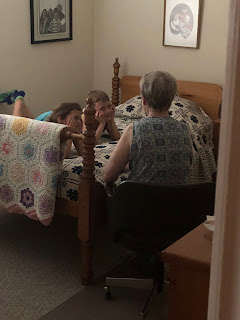
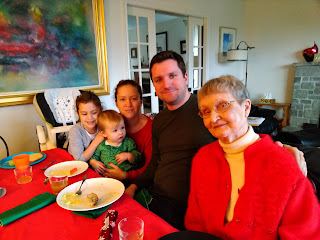
She usually ate well (or almost perfectly) - this sundae was an exception. Story time with her great grandkids. And last Christmas.

About Me

Name: Jim Estill
Location: Guelph, Ontario, Canada
My views on leadership, time management, life and innovation.
Family Member Blogs:
Glen Estill
Lyle Estill
NSCBlog
Other Blogs
The Waterloo Wellington Bloggers Association
Previous Posts
- The Pandemic Made Me Realize I had Choice
- The best recipe ever by Victoria
- Branding in a Digital World by Hilary Topper Review
- Thriving for Today - despite covid
- Ventilators - How Danby Appliances got to Where We...
- Same World - Same Suffering
- Tips for Working Well at Home
- Coronavirus might help the environment
- Coronavirus Impact
- Thanksgiving and Sales Process Tracking
Archives
- May 2005
- June 2005
- July 2005
- August 2005
- September 2005
- October 2005
- November 2005
- December 2005
- January 2006
- February 2006
- March 2006
- April 2006
- May 2006
- June 2006
- July 2006
- August 2006
- September 2006
- October 2006
- November 2006
- December 2006
- January 2007
- February 2007
- March 2007
- April 2007
- May 2007
- June 2007
- July 2007
- August 2007
- September 2007
- October 2007
- November 2007
- December 2007
- January 2008
- February 2008
- March 2008
- April 2008
- May 2008
- June 2008
- July 2008
- August 2008
- September 2008
- October 2008
- November 2008
- December 2008
- January 2009
- February 2009
- March 2009
- April 2009
- May 2009
- June 2009
- July 2009
- August 2009
- September 2009
- October 2009
- November 2009
- December 2009
- January 2010
- February 2010
- March 2010
- April 2010
- May 2010
- June 2010
- July 2010
- August 2010
- September 2010
- October 2010
- November 2010
- December 2010
- January 2011
- February 2011
- March 2011
- April 2011
- May 2011
- June 2011
- July 2011
- August 2011
- September 2011
- October 2011
- November 2011
- December 2011
- January 2012
- February 2012
- March 2012
- April 2012
- May 2012
- June 2012
- July 2012
- August 2012
- September 2012
- October 2012
- November 2012
- December 2012
- January 2013
- February 2013
- March 2013
- April 2013
- May 2013
- June 2013
- July 2013
- August 2013
- September 2013
- October 2013
- November 2013
- December 2013
- January 2014
- February 2014
- March 2014
- April 2014
- May 2014
- June 2014
- July 2014
- August 2014
- September 2014
- October 2014
- November 2014
- December 2014
- January 2015
- February 2015
- March 2015
- April 2015
- May 2015
- June 2015
- July 2015
- August 2015
- September 2015
- October 2015
- November 2015
- January 2016
- February 2016
- March 2016
- April 2016
- May 2016
- June 2016
- July 2016
- August 2016
- September 2016
- November 2016
- December 2016
- January 2017
- February 2017
- March 2017
- April 2017
- May 2017
- June 2017
- July 2017
- August 2017
- September 2017
- October 2017
- November 2017
- December 2017
- January 2018
- February 2018
- March 2018
- April 2018
- June 2018
- July 2018
- August 2018
- September 2018
- October 2018
- December 2018
- February 2019
- March 2019
- April 2019
- May 2019
- June 2019
- August 2019
- October 2019
- February 2020
- March 2020
- April 2020
- May 2020
- April 2021
- June 2021